Why early Digital Product Passports are about profits and market access, with compliance following close behind

Executive Summary
The EU’s Ecodesign for Sustainable Products Regulation (ESPR) will fundamentally change how metal products are documented, traded, and accessed in European markets. While full enforcement is approaching in stages, procurement requirements are already shifting. For metal manufacturers, Digital Product Passports are quickly becoming a condition for market access rather than a future compliance task.
Protag enables manufacturers to prepare early — without adding complexity. Protag does not replace existing ERP, quality, or sustainability systems. Instead, it connects them, automatically pulling relevant product and process data and structuring it into Digital Product Passports that are ready for ESPR and beyond.
By closing data gaps through automation, Protag significantly reduces manual documentation work, lowers compliance overhead, and frees up internal resources across operations, sustainability, and sales. At the same time, structured and trusted product data strengthens customer relationships, accelerates sales processes, and unlocks access to future markets where traceability and verified sustainability are expected.
For the metal industry, early DPP adoption is not just about regulatory readiness — it is a strategic opportunity to reduce costs, increase profitability, and position the company as a preferred, future-ready supplier. Protag delivers the infrastructure to make this transition seamless, scalable, and commercially valuable.
Structural shift in the EU and beyond
The European metal industry is approaching a structural shift that will redefine how products are documented, traded, and valued. Driven by the EU’s sustainability ambitions, the Ecodesign for Sustainable Products Regulation (ESPR) introduces Digital Product Passports (DPPs) as a new foundation for market access.
For manufacturers of steel, aluminium, copper, and other metals, this change is often framed as a compliance challenge. In reality, it is something far more strategic. ESPR is not just about regulation, it is about how value is proven and transferred in future markets.
This is exactly where Protag creates its value. Not by adding another system or layer of bureaucracy, but by quietly connecting what manufacturers already have, and turning fragmented data into a commercial advantage.
ESPR is changing what “market ready” means
Under ESPR, products placed on the EU market will increasingly need to be accompanied by structured, machine-readable information. For the metal industry, this means that material composition, origin, recycled content, carbon footprint, and key process documentation must be accessible through a Digital Product Passport.
The regulation is being developed and rolled out under the framework of the European Union, with metals identified as one of the priority product categories due to their environmental impact and central role in European industry.
While mandatory enforcement is still approaching in stages, procurement requirements are moving faster than legislation. Large buyers, infrastructure projects, and public tenders are already beginning to demand traceability, documentation, and verified sustainability data. In practice, this means that DPP readiness is becoming a prerequisite for doing business, long before ESPR formally requires it in 2028.
Expected timeline (metals – indicative)
• 2025–2026: delegated acts & pilot requirements
• 2026–2027: voluntary adoption becomes procurement advantage
• 2027–2028: mandatory DPP requirements for prioritized metal categories
• 2028+: full enforcement and cross-border market dependency
The real challenge: data exists, but it is disconnected
Most metal manufacturers already generate vast amounts of relevant data. ERP systems track production and batches. Quality systems document testing and certifications. Sustainability teams prepare carbon calculations and environmental declarations. Sales teams respond to customer documentation requests on a daily basis.
The problem is not missing information.
The problem is that this information lives in silos.
Data is exchanged manually, often by email or spreadsheets. The same documents are recreated for different customers and markets. Compliance work grows year by year, without creating lasting value for the business, only increasing cost and overheads. ESPR simply exposes this inefficiency, it does not create it.
This is the gap Protag is built to close. Protag decreases time spent on documentation overheads in manufacturing firms with 30 – 90 %. Thereby removing huge costs for manufacturers.
Protag’s red thread: automation, not replacement
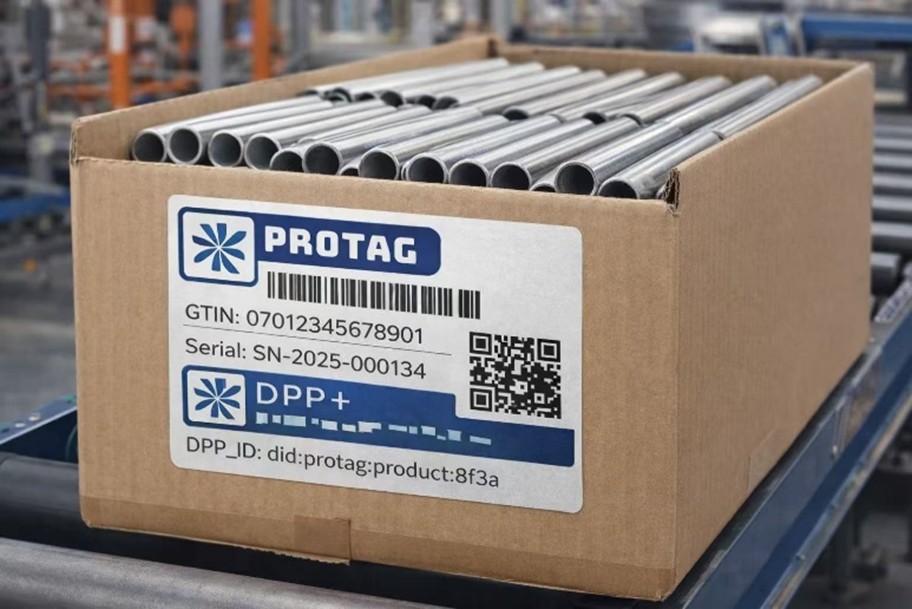
Protag is not designed to replace existing systems. Instead, it acts as a connective layer that pulls relevant product and process data from where it already exists and structures it into Digital Product Passports.
By automating the flow of information across systems, Protag eliminates repetitive manual work and turns compliance into a continuous, low-effort process rather than a recurring project. Product data is maintained once, updated automatically, and reused across customers, markets, and regulatory frameworks.
This approach delivers immediate benefits:
- less administrative overhead,
- fewer errors,
- faster response times,
- strategic resource reallocation,
- increased topline,
- and far better internal transparency.
Over time, it also creates something more powerful, a single source of truth that connects production, compliance, sales, and sustainability.
Why DPPs quickly become a business driver
It is easy to wrongly perceive Digital Product Passports as a cost imposed by regulation. What early adopters are discovering, however, is that DPPs rapidly turn into a commercial asset. This is also shown by industry reports.
When product data is structured, accessible, and trusted, customer onboarding becomes faster. Sales teams spend less time chasing documents and more time closing deals. Procurement conversations shift from price alone to verified quality, traceability, and sustainability. In secondary markets, traceable metals with documented composition and origin retain higher value and are easier to reuse or recycle.
In short, the same infrastructure that supports ESPR compliance also reduces internal costs and strengthens market positioning. This is one more of the spheres where Protag’s value extends far beyond regulation.
Preparing early creates market pull

The expected ESPR timeline for metals indicates gradual enforcement between 2026 and 2028. But market behaviour is already changing. Especially in the EU and US. Buyers are beginning to favour suppliers that can provide structured product data today, not promises for tomorrow.
Manufacturers that adopt Digital Product Passports early position themselves as low-risk, future-ready partners. This creates a clear pull effect: customers start to expect DPP-enabled products, and suppliers without them are quietly filtered out.
Protag enables manufacturers to make this transition without disrupting operations. By integrating into existing workflows, the platform supports gradual adoption while delivering immediate operational benefits.
A platform built for industrial reality
Metal manufacturing is complex, capital-intensive, and margin-sensitive. Protag is built with this reality in mind. The platform works in brownfield environments, across fragmented supply chains, and alongside existing ERP, PIM, quality, and sustainability systems.
Rather than adding complexity, Protag removes it. Documentation becomes reusable. Compliance becomes automated. Data becomes an asset instead of a burden.
The outcome is simple and tangible:
Time saved, costs reduced, and peace of mind restored.
Meeting the industry where decisions are made
Protag actively engages with manufacturers and decision-makers across Europe, US and Asia, including structured outreach through strategic partners. By connecting directly with executives, sustainability leaders, operations managers, and commercial teams, Protag positions Digital Product Passports not as an IT project, but as a strategic investment.
The message is consistent:
Protag delivers world-class Digital Product Passport and product documentation software that enables access to future markets, increases profitability, and frees up valuable internal resources.
The Key Takeaway
ESPR is not simply another regulatory hurdle for the metal industry. It is a signal that markets are changing; towards transparency, traceability, and verified sustainability.
Manufacturers that act early will not only stay compliant, but gain a lasting competitive advantage.
Protag is the platform that makes this shift seamless, profitable, and sustainable.
References
European Commission (2022) Proposal for a Regulation on Ecodesign for Sustainable Products (ESPR). Brussels: European Commission. Available at: https://environment.ec.europa.eu/publications/ecodesign-sustainable-products-regulation_en (Accessed: 8 January 2026).
European Commission (2023) Digital Product Passport: A cornerstone of the EU’s sustainable product policy. Brussels: European Commission. Available at: https://environment.ec.europa.eu/topics/circular-economy/digital-product-passport_en (Accessed: 8 January 2026).
European Parliament and Council of the European Union (2024) Ecodesign for Sustainable Products Regulation (ESPR) – adopted text. Official Journal of the European Union.
European Commission Joint Research Centre (JRC) (2023) Digital Product Passport: Policy framework and technical building blocks. Luxembourg: Publications Office of the European Union.
World Steel Association (2023) Steel and the circular economy. Brussels: World Steel Association. Available at: https://worldsteel.org (Accessed: 8 January 2026).
European Aluminium (2023) Aluminium circularity and traceability in Europe. Brussels: European Aluminium. Available at: https://european-aluminium.eu (Accessed: 8 January 2026).
Ellen MacArthur Foundation (2022) Completing the picture: How the circular economy tackles climate change. Cowes: Ellen MacArthur Foundation.
GS1 (2023) Digital Product Passport and the role of global standards. Brussels: GS1 AISBL. Available at: https://www.gs1.org (Accessed: 8 January 2026).
McKinsey & Company (2022) Sustainability in metals and mining: From compliance to competitive advantage. McKinsey Insights.
Boston Consulting Group (BCG) (2023) Digital traceability as a driver of industrial competitiveness. Boston: BCG.
Protag Systems AS (2025) Digital Product Passports beyond compliance. Oslo: Protag Systems. Available at: https://www.protagsystems.io (Accessed: 8 January 2026).